Right now, while most people are still typing prompts into ChatGPT for fun, a smaller group has quietly figured out how to turn the AI boom into a genuine income stream — without building a single piece of software themselves. They’re not coders. They’re not tech founders. They’re everyday content creators who learned how to start AI affiliate marketing for beginners and positioned themselves at the intersection of the fastest-growing industry in a generation and one of the oldest, most reliable online income models that exists.

If you’ve been watching the AI explosion from the sidelines wondering how to actually benefit from it financially, this might be the most beginner-friendly entry point available.
The timing here matters enormously. AI tools are launching by the dozens every month — writing assistants, image generators, video editors, coding copilots, productivity bots — and nearly every one of them needs new users. Most of these companies have realized that affiliate and referral programs are one of the cheapest, most effective ways to acquire customers, which means the door is wide open for beginners willing to walk through it.
How to Start AI Affiliate Marketing for Beginners: Understanding the Opportunity
AI affiliate marketing works exactly like traditional affiliate marketing, with one key difference: the products being promoted are AI-powered software, tools, and platforms rather than physical goods or general digital products. You sign up for an AI company’s affiliate program, receive a unique tracked link, and earn a commission whenever someone uses that link to subscribe or purchase.
What makes this niche especially attractive for anyone researching how to start AI affiliate marketing for beginners is the commission structure. Because most AI tools operate on a software-as-a-service (SaaS) subscription model, commissions are often recurring — meaning you get paid every single month a referred customer stays subscribed, not just once at the point of sale. Rates commonly range from 20% to 50% of the subscription price, and some programs pay for a full year or even for the customer’s lifetime.
Why AI Tools Make Such Strong Affiliate Products
Several factors make this niche particularly forgiving for someone just getting started.
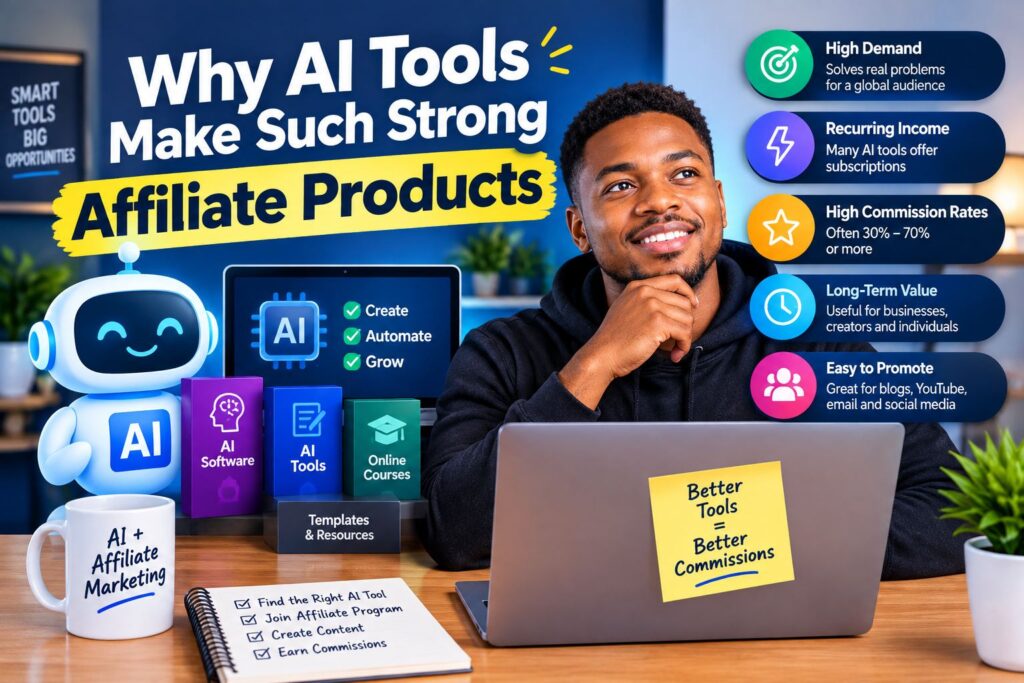
First, the category is genuinely new and rapidly evolving, meaning search demand for reviews, tutorials, and comparisons is exploding while competition, in many specific sub-niches, is still relatively thin.
Second, AI tools tend to solve immediate, tangible problems — writing faster, editing video more easily, automating repetitive tasks — which makes them easy to demonstrate and easy for an audience to understand the value of quickly.
Third, many AI companies offer generous free trials or freemium tiers, lowering the barrier for your audience to try the product after clicking your link, which naturally improves conversion rates.
Step 1: Choose Your AI Niche
The AI space is enormous, so beginners benefit from narrowing their focus rather than trying to cover everything. Popular sub-niches include:
AI writing and content tools (like long-form writing assistants, grammar checkers, and SEO content generators)
AI image and video generation (tools that create graphics, edit video, or generate avatars)
AI productivity and automation tools (chatbot builders, workflow automation, scheduling assistants)
AI coding assistants (tools that help developers write, debug, or review code)
AI marketing tools (ad copy generators, email automation, social media schedulers)
Choosing a niche you already understand or use personally makes content creation dramatically easier, since you’ll be reviewing tools from genuine, firsthand experience rather than researching from scratch.
Step 2: Find AI Affiliate Programs Worth Joining
Once you’ve settled on a niche, research which tools in that space offer affiliate programs. Many AI companies list their programs directly on their websites, often in the footer under “Affiliates” or “Partners.” Others run their programs through affiliate networks like PartnerStack, Impact, or ShareASale, which can be useful because they let you manage multiple AI affiliate partnerships from a single dashboard.
When evaluating programs, pay attention to commission percentage, whether commissions are recurring or one-time, the length of the cookie window, and the minimum payout threshold. A program offering 30% recurring commissions on a $50/month tool can significantly outearn a one-time 50% commission on a low-cost product, simply because the income compounds with every referred customer who stays subscribed.
Step 3: Build a Platform to Share Your Content
Just like any affiliate marketing model, you need somewhere to actually publish your recommendations. For anyone figuring out how to start AI affiliate marketing for beginners, a few platforms tend to work particularly well given how visual and demonstration-friendly AI tools are:
YouTube is arguably the strongest fit for this niche, since screen-recorded tutorials and tool comparisons let viewers see the AI tool in action before committing to try it themselves.
A blog or niche website works well for in-depth reviews, “best AI tools for X” roundup posts, and comparison articles that capture people actively researching options through search engines.
TikTok and Instagram Reels are increasingly popular for quick AI tool demonstrations, since short-form video does a great job of showing a “wow” moment — like an AI generating a polished image or article in seconds.
Twitter/X, particularly within tech and startup communities, can also drive meaningful traffic, since AI discussions and tool recommendations circulate heavily in that space.
Step 4: Create Content That Demonstrates Real Value
Generic promotional posts rarely convert in this space, largely because the AI audience tends to be curious and somewhat skeptical, having already seen plenty of hype. Content that performs best tends to focus on demonstration and honest evaluation rather than pure promotion.
Tutorial and walkthrough content showing exactly how to use a tool to solve a specific problem tends to convert well, since it proves the tool’s value rather than just claiming it.
Comparison content, such as “Tool A vs. Tool B for content writers,” captures an audience that’s already decided to buy something in the category and just needs help choosing.
Use-case-specific content, like “5 AI Tools Every Freelance Writer Needs,” speaks directly to a defined audience segment and tends to convert better than broad, generic AI content.
Honest review content, including both strengths and limitations of a tool, builds far more trust than uncritical hype, especially in a space where audiences have grown wary of overblown AI claims.
Step 5: Drive Traffic and Optimize Over Time
Once your content is live, growth comes down to consistent traffic generation and refinement. SEO remains one of the most durable strategies here, since AI-related search terms are experiencing enormous growth in search volume, and well-optimized content can rank and convert for months or years.
Repurposing content across platforms — turning a YouTube tutorial into a blog post, then into a short-form clip — helps maximize the return on the time spent creating it in the first place.
Tracking which specific tools, content formats, and platforms convert best allows you to double down on what’s working rather than spreading effort evenly across everything. Given how quickly the AI landscape shifts, revisiting and updating older content regularly also helps maintain accuracy and search rankings as tools evolve or get replaced by newer competitors.
Common Mistakes Beginners Make in This Niche
The biggest mistake beginners make is promoting AI tools they haven’t actually used, relying purely on the company’s own marketing copy. This tends to produce shallow, generic content that fails to rank well and fails to convert, since audiences can usually tell the difference between genuine experience and secondhand promotion.
Another common pitfall is chasing every new AI tool that launches rather than building depth in a specific niche. The AI space moves fast, and it’s tempting to jump on every trending tool, but scattered content rarely builds the kind of topical authority that search engines and audiences reward over time.
Failing to disclose affiliate relationships is another risk worth taking seriously, both from a legal standpoint and a trust standpoint, particularly in a niche where audiences are already primed to be skeptical of hype and financial incentives behind recommendations.
Finally, many beginners underestimate how quickly this space changes. A tool that’s cutting-edge today might be replaced by a stronger competitor within months, so content and recommendations benefit from regular review and updates rather than being published once and forgotten.
Realistic Expectations and Long-Term Potential
Anyone serious about how to start AI affiliate marketing for beginners should go in with realistic expectations about timeline. Early months typically involve building an audience and testing which tools and content formats resonate, with modest commissions trickling in as trust builds.
Because many AI programs offer recurring commissions, however, income in this niche has a tendency to compound meaningfully over time — each new referred subscriber adds to a growing monthly baseline, rather than requiring constant new sales just to maintain the same income level.
The Bottom Line
The AI industry’s rapid growth has created a rare window of opportunity for affiliate marketers willing to move early and build genuine expertise in the space.
For beginners wondering how to start AI affiliate marketing for beginners, the path forward mirrors any solid affiliate strategy: choose a focused niche, partner with reputable programs offering recurring commissions, create honest and demonstration-driven content, and stay consistent while the space continues to grow.
With AI tools becoming more embedded in everyday work and creativity, the affiliates who build authority and trust in this niche now are well-positioned to keep earning as the industry — and the demand for guidance navigating it — continues to expand.