Somewhere right now, someone with zero coding skills, no email list, and no prior marketing experience is using AI tools to research a niche, draft a product review, and publish content that will quietly earn commissions while they sleep. That’s not a hypothetical — it’s the reality of how much artificial intelligence has lowered the barrier to entry for affiliate marketing. you’ve ever wanted to build an online income stream but assumed it would take years of trial and error to figure out, learning how to start AI affiliate marketing for beginners might be the fastest, most forgiving on-ramp available today.

This guide walks through exactly how to get started — from picking a niche to publishing your first AI-assisted content — along with the tools, strategies, and mistakes to avoid as you build toward a sustainable affiliate income.
What Is AI Affiliate Marketing?
AI affiliate marketing is traditional affiliate marketing — promoting other companies’ products and earning a commission on resulting sales — enhanced by artificial intelligence tools at nearly every stage of the process.
Instead of manually digging through keyword spreadsheets, staring at a blank page trying to write an article, or guessing which products will actually sell, beginners can use AI to:
Identify profitable niches and keyword opportunities
Draft content for reviews, guides, and product comparisonsOptimize pages for search engine visibility
Analyze performance data and flag what needs improvementAutomate repetitive tasks like social scheduling and email follow-ups
The underlying business model hasn’t changed. What’s changed is how quickly a single person, working alone, can now research, produce, and optimize content that used to require a small team.
How to Start AI Affiliate Marketing
Starting an AI-powered affiliate business follows a fairly logical sequence once you understand the pieces involved
Rather than treating AI as a single magic tool, think of it as support woven into each stage of a process that has always driven affiliate success: choosing a niche, publishing helpful content, and building an audience that trusts your recommendations.
Step 1: Validate a Niche With AI-Backed Research
Every affiliate journey begins with choosing a niche — a specific topic or product category your content will revolve around.
Beginners often stumble here, either picking something too broad or choosing a topic based purely on personal interest without checking whether real demand exists.
AI-powered research tools remove much of the guesswork. Instead of relying on gut instinct, you can quickly check:Search volume for potential niche topics
Competition level, or how difficult it will be to rank new content
Commercial intent, meaning whether people are searching to buy rather than just to browse
Ask an AI research tool to compare several niche ideas side by side, weighing search demand, typical commission rates, and how saturated the space already is. Niches with steady search volume, moderate competition, and clear purchase intent — budget tech accessories, home fitness gear, pet supplies, personal finance tools — tend to be more forgiving starting points.
Step 2: Join Relevant Affiliate Programs
With a niche chosen, sign up for affiliate programs that fit it. Most beginners start with a mix of:Amazon Associates, for broad product selection and easy approval
Niche-specific networks like ShareASale, CJ Affiliate, or Impact, often with better commissions for specialized products
Software and SaaS programs, which frequently offer recurring commissions that compound into steadier income over time
Step 3: Build a Simple Content Platform
You’ll need somewhere to publish content and place affiliate links — typically a website, since it builds lasting organic traffic rather than depending entirely on a single platform’s algorithm. AI-assisted website builders can now generate a working starter site from a short description of your niche, helping beginners skip weeks of design work before publishing anything.
How to Start Affiliate Marketing With AI
Once the foundational pieces are in place, the real advantage of an AI-powered approach shows up in how you actually produce and refine content. This is where beginners see the biggest time savings compared to building an affiliate business entirely by hand.

A practical AI-supported content workflow like this:
Keyword research: Use an AI SEO tool to surface long-tail, purchase-intent keywords, such as “best affordable air purifiers for small apartments” instead of just “air purifiers.”Outline generation: Have an AI writing tool build a structured outline based on top-ranking content for that keyword, then adjust it to reflect your own angle.
Draft writing: Generate a first draft, then rewrite key sections in your own voice, weave in personal experience if you’ve tested the product, and correct anything inaccurate.
On-page optimization: Run the finished piece through an AI SEO checker to review keyword placement, heading structure, and readability before publishing.
Beyond content, AI also supports the analytical side of affiliate marketing. Once your site has some traffic, AI-powered analytics tools can highlight which pages are converting, which traffic sources are bringing in buyers rather than just visitors, and where a page might benefit from a stronger call-to-action or a comparison table.
The content formats that tend to perform well for AI-assisted affiliate beginners include standalone product reviews, “best of” roundup lists, how-to guides that naturally lead into a product recommendation, and head-to-head comparisons between two competing products.
How to Start Affiliate Marketing With AI Tools
Knowing which specific categories of tools to use — and how they fit together — makes the difference between scattered experimentation and a repeatable system.
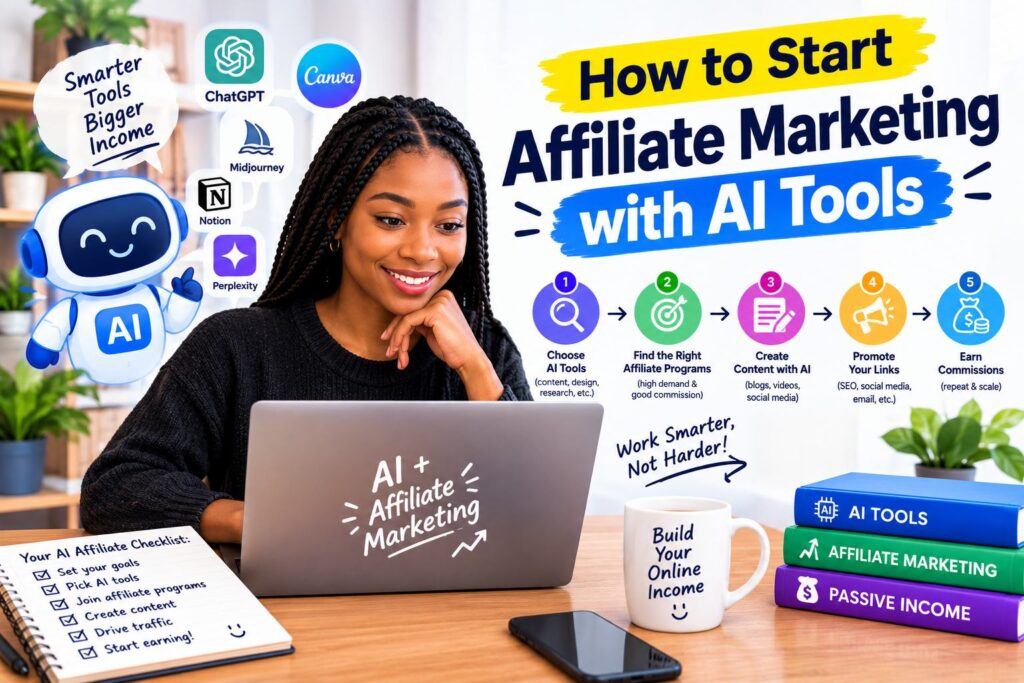
Beginners generally benefit from having at least one tool in each of these categories, rather than trying to do everything manually or subscribing to a dozen overlapping platforms at once.
An AI writing assistant for drafting and outlining content, used as a starting point that you then edit, fact-check, and personalize rather than publish untouched
An AI-powered keyword and SEO research tool to identify content opportunities and optimize pages for search visibilityA website analytics platform to monitor traffic, click-through rates on affiliate links, and which pages are actually generating commissions
An affiliate network dashboard to track clicks and commissions across the different programs you’re promotingRather than subscribing to every available tool right away, most beginners are better served starting with one or two free or low-cost options per category, upgrading only once a specific bottleneck shows up in their workflow.
A common early bottleneck, for example, is content production speed — once you notice research and drafting are eating most of your time, that’s the signal to invest in a stronger AI writing or research tool.It’s worth being clear about what these tools are for: speeding up research and production, not replacing genuine product knowledge or honest opinions.
Search engines and readers increasingly reward content with real first-hand experience, so the beginners who succeed treat AI tools as a productivity layer sitting underneath their own judgment, not a replacement for it.
How to Start AI Affiliate Marketing for Beginners
Bringing everything together, here’s a condensed path specifically for someone starting from zero, with no prior affiliate experience and no existing audience.

Pick one niche using AI-backed keyword and demand research, resisting the urge to cover multiple unrelated topics at once.Join two or three affiliate programs that fit that niche, prioritizing ones with reasonable commission rates and a track record of paying affiliates reliably.
Set up a simple website, using an AI website builder or a basic WordPress install, focused on a clean, readable layout rather than elaborate design.Publish your first five to ten pieces of content, using AI to speed up research and drafting, but personally reviewing, fact-checking, and adding your own voice to every piece before it goes live.
Track performance from day one, using AI analytics tools to see which content and which products are actually converting, rather than guessing based on traffic alone.Extend your reach beyond search, repurposing content into short videos, social posts, or an email newsletter using AI to speed up the adaptation process for each format.
Iterate based on data, doubling down on the content types and products that are demonstrably working rather than spreading effort evenly across everything.
A few beginner mistakes are worth flagging specifically at this stage: publishing AI drafts without review, chasing high commission rates on products with little real demand, skipping affiliate disclosure requirements, and expecting fast results.
AI speeds up production, but search engines still need time to trust and rank new content, and most beginners won’t see meaningful income for several months even with an efficient workflow.
How to Start an AI Affiliate Marketing Business
Moving from a side project to something that functions like an actual business requires a slightly different mindset than simply publishing content and hoping for commissions.

A few shifts separate a hobby-level attempt from a genuine business:
Treat content as inventory, not one-off posts. A real affiliate business builds a growing library of evergreen content that continues generating traffic and commissions over time, rather than relying on sporadic, disconnected publishing.Diversify traffic and income sources.
Depending entirely on one traffic channel or one affiliate program leaves the business vulnerable to a single algorithm change or program policy shift. Spreading across organic search, email, and social content, along with multiple affiliate programs, builds resilience.
Reinvest early earnings strategically.
As commissions start coming in, reinvesting in stronger AI tools, a better website theme, or outsourced help for tasks outside your strengths (like technical SEO or video editing) can accelerate growth beyond what’s possible working entirely solo.Build systems, not just content.
Documenting your own content workflow — the AI prompts you use, your editing checklist, your publishing schedule — makes it far easier to stay consistent and, eventually, to bring on help without losing quality.
Track the business like a business. Basic bookkeeping, tracking which niches and products are actually profitable after accounting for tool subscriptions and any ad spend, and setting concrete monthly goals all separate a sustainable business from an unpredictable side hustle.
Many people who start with a single niche site eventually expand into multiple sites, additional content formats like YouTube or a podcast, or even creating their own digital products once they understand what their audience responds to.
The AI tools that helped you publish your first ten articles are the same category of tools that can help you scale to fifty or a hundred, provided the underlying strategy — real value, genuine trust, and diversified traffic — stays intact.
Common Mistakes to Avoid
A handful of mistakes tend to show up repeatedly among beginners in this space:Publishing unedited AI content, which often contains generic phrasing or claims that don’t match the actual product
Choosing a niche based on commission rate alone, without checking real search demand first
Relying on a single traffic source, leaving the entire business exposed to one platform’s changes
Skipping affiliate disclosures, which is a legal requirement in most regions, not an optional courtesy
Expecting overnight results, when realistic timelines for meaningful income are typically measured in months, not days
Final Thoughts
Learning how to start AI affiliate marketing for beginners comes down to combining the same fundamentals that have always driven affiliate success — a focused niche, genuinely useful content, and consistent traffic — with AI tools that remove much of the manual grunt work along the way.
By validating your niche with real data, using AI to accelerate research and content production, tracking performance from the start, and gradually shifting from a side project toward a structured business, you can build a foundation far faster than was possible even a few years ago.
The tools will keep evolving, but the beginners who succeed will be the ones using AI to work smarter, not as a substitute for genuine effort and audience trust.