How can AI improve affiliate marketing strategies and help affiliates turn more clicks into conversions? Affiliate marketing has always been a numbers game — the right offer, in front of the right audience, at the right time.
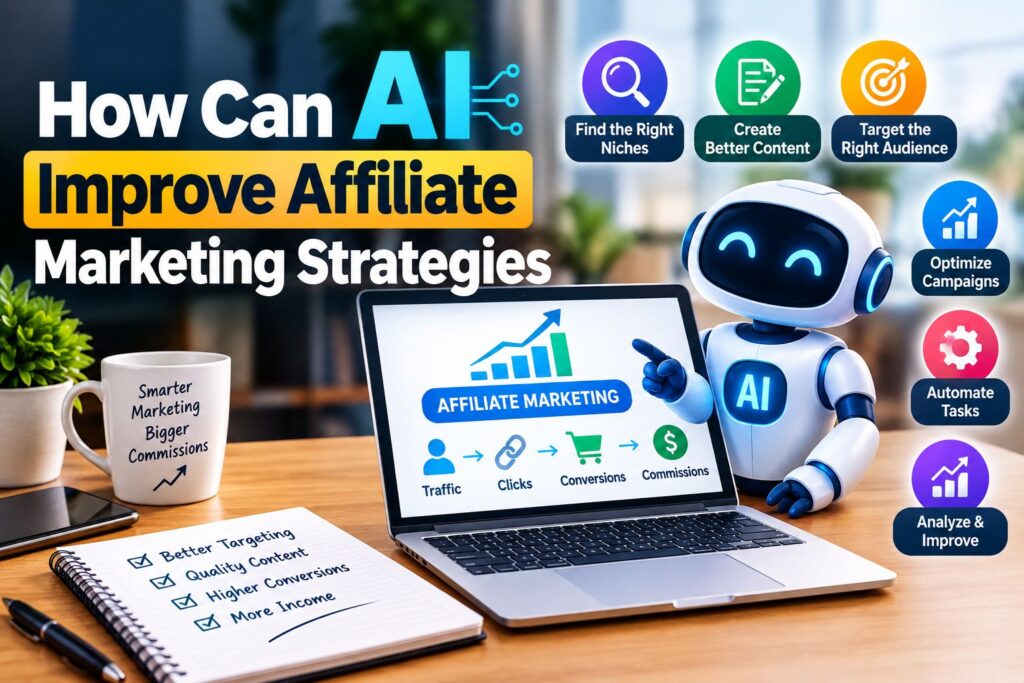
For years, affiliates and marketing teams relied on manual research, gut instinct, and slow A/B testing to improve those numbers.
That’s changing fast. Artificial intelligence is now woven into nearly every stage of the affiliate marketing funnel, from finding profitable niches and identifying high-potential audiences to creating content, optimizing campaigns, tracking performance, and detecting fraud before it eats into commissions.
So, how can AI improve affiliate marketing strategies in practical, measurable ways? Below is a detailed look at where AI is already making a difference and how affiliates and brands can use it to work smarter, move faster, and build more profitable campaigns.
1. Smarter Audience Targeting and Segmentation
One of the biggest advantages AI brings to affiliate marketing is its ability to process enormous amounts of behavioral data and turn it into actionable audience segments. Traditional targeting relied on broad demographics — age, location, general interests.
AI-driven targeting goes much deeper.Machine learning models can analyze browsing history, purchase patterns, click behavior, and even time-of-day activity to build detailed audience profiles.
This means affiliates can:
– Identify which visitor segments are most likely to convert on a specific offer
– Personalize landing pages and calls-to-action based on visitor intent
– Predict which products a segment is likely to buy next, enabling smarter cross-promotion
Instead of blasting the same offer to an entire email list or ad audience, AI tools can dynamically match individual users with the affiliate offers most relevant to them, increasing click-through and conversion rates without increasing ad spend.
2. Content Creation and Optimization at Scale
Content is the backbone of most affiliate strategies — product reviews, comparison articles, buying guides, and tutorials all drive organic traffic and build trust with readers.
AI writing tools have made it possible to produce this content faster, though the real value comes from using AI as a research and optimization partner rather than a replacement for editorial judgment.
Here’s where AI adds genuine value in affiliate content:
– Keyword and topic research: AI tools can surface long-tail keyword opportunities and content gaps competitors haven’t covered, which is especially valuable for niche affiliate sites competing against larger publishers.
– Draft generation: AI can produce first drafts of product comparisons, FAQs, and structured buying guides, which human editors then refine with genuine product experience and brand voice.
– On-page optimization: AI-powered SEO tools analyze existing top-ranking content and suggest header structures, word counts, and semantic keywords that improve the odds of ranking.
– Repurposing: A single long-form review can be turned into social captions, email snippets, and video scripts using AI, multiplying the reach of one piece of content.
The affiliates who benefit most treat AI as a force multiplier for research and speed, while keeping real product testing and honest opinions front and center — both because readers can tell the difference, and because search engines increasingly reward first-hand experience.
3. Predictive Analytics for Offer and Program Selection
Choosing which affiliate programs and products to promote is often based on commission rates or personal familiarity.
AI changes this by allowing marketers to forecast performance before committing time and traffic to an offer.
Predictive analytics tools can evaluate historical conversion data, seasonal demand trends, and even sentiment from product reviews to estimate:
– Which products are likely to see a demand spike in the coming weeks or months
– Which affiliate networks or merchants have historically higher earnings-per-click for a given niche
– How a new offer is likely to perform based on similarities to past successful campaignsThis shifts affiliate strategy from reactive to proactive.
Instead of waiting to see which campaigns underperform, marketers can allocate budget and content resources toward offers that data suggests will perform well, reducing wasted effort on low-converting promotions.
4. Dynamic Pricing and Offer Personalization
Some advanced affiliate platforms now use AI to personalize not just the messaging around an offer, but the offer itself. Dynamic pricing engines can adjust discount codes, bundle suggestions, or bonus incentives shown to a visitor based on their likelihood to convert.
For example, a visitor who has shown high purchase intent (multiple product page visits, cart additions) might see a lower-friction offer, like free shipping, while a first-time visitor might see a more attention-grabbing discount to encourage the first click.
AI models continuously test and adjust these variables in real time, something that would be nearly impossible to manage manually across large volumes of traffic.
5. Chatbots and Conversational Recommendations
AI-powered chatbots have moved well beyond simple customer service scripts. On affiliate sites, conversational AI can act as a virtual shopping assistant, asking visitors a few questions about their needs and then recommending specific products with affiliate links embedded naturally in the conversation.
This approach improves the user experience in a few key ways:
– Visitors get personalized recommendations instead of scrolling through generic “best of” lists
– Engagement time increases, which can positively affect SEO signals
– Conversion rates tend to be higher because the recommendation feels tailored rather than promotional
Quiz-style AI tools (“Find your perfect skincare routine” or “Which laptop fits your budget?”) are a popular variation of this, using a short series of questions to funnel visitors toward the most relevant affiliate product.
6. Fraud Detection and Traffic Quality Control
Affiliate fraud — fake clicks, bot traffic, cookie stuffing, and incentivized fraudulent sign-ups — costs the industry a significant amount of revenue every year.
This is an area where AI has arguably made the biggest operational impact, because pattern detection at scale is exactly what machine learning is built for.
AI fraud detection systems can:
– Flag unusual click patterns, such as a spike in clicks from a single IP range or device fingerprint
– Detect bot-like browsing behavior that doesn’t match genuine human interaction patterns
– Identify affiliates whose conversion rates deviate suspiciously from network averages
– Continuously learn from new fraud patterns, adapting faster than static rule-based systems
For affiliate networks and brands running large-scale programs, this protects marketing budgets and ensures commissions are paid out fairly to legitimate affiliates rather than bad actors gaming the system.
7. Performance Tracking and Attribution Modeling
Multi-touch attribution has always been a challenge in affiliate marketing — a customer might click an affiliate link, leave, see a retargeting ad, then convert weeks later through a different channel entirely.
AI-driven attribution models are far better equipped to handle this complexity than traditional last-click attribution.
Machine learning attribution models can:
– Weigh the influence of each touchpoint in a customer’s journey more accurately
– Account for cross-device behavior, connecting a mobile click to a desktop purchase
– Provide affiliates with clearer insight into which content pieces or channels are actually driving revenue, not just clicks
This matters because affiliates who understand true attribution can double down on the content and channels doing the real work, rather than the ones that simply appear first in a linear click path.
8. Automated A/B Testing and Optimization
Traditional A/B testing requires setting up variants, waiting for statistically significant data, and manually implementing the winning version.
AI-powered testing tools compress this cycle significantly through multivariate testing and automated optimization.
Instead of testing one headline against another, AI systems can simultaneously test dozens of combinations of headlines, images, CTAs, and page layouts, automatically shifting traffic toward the best-performing combination in near real time.
This is particularly valuable for affiliate landing pages, where even small improvements in conversion rate directly translate into commission revenue.
9. Voice Search and Visual Search
OptimizationAs voice assistants and visual search tools become more common, AI is helping affiliate marketers adapt content to these newer discovery methods.
AI tools can analyze how conversational, question-based queries differ from typed searches and help restructure content — using more natural language, FAQ formatting, and concise direct answers — to capture voice search traffic.
Similarly, AI-powered image recognition allows platforms like Pinterest and Google Lens to match a photo to visually similar products, opening a new discovery channel for affiliates in fashion, home decor, and similar visual-heavy niches.
10. Predictive Customer Lifetime Value for Program Prioritization
Not all conversions are equal.
AI models can estimate the predicted lifetime value of a customer acquired through a specific affiliate channel, not just the value of their first purchase.
This helps affiliate managers and marketers prioritize partnerships and content strategies around programs that bring in higher-value, longer-retained customers rather than one-time bargain shoppers.
For affiliates working with recurring-revenue products like subscriptions or SaaS tools, this kind of insight is especially valuable, since a slightly lower initial commission on a high-retention product can outperform a higher one-time payout from a low-retention product over time.
Practical Steps to Start Using AI in Affiliate Marketing
For marketers looking to apply these ideas, a gradual, tool-by-tool approach tends to work better than trying to overhaul an entire strategy at once:
1. Start with content research tools to identify keyword gaps and content opportunities specific to your niche.
2. Add an AI writing assistant to speed up first drafts, while keeping human review for accuracy and authenticity.
3. Implement basic analytics AI to track which content and offers are actually converting, not just generating clicks.
4. Layer in fraud detection if working with a network or managing sub-affiliates, to protect commission integrity.
5. Experiment with personalization tools, such as quiz-based recommendations, once traffic volume justifies the investment.
The Human Element Still Matters
It’s worth noting that AI’s role in affiliate marketing is best understood as augmentation rather than replacement. Search engines and readers alike are increasingly favoring content with genuine first-hand product experience, honest pros-and-cons, and a recognizable voice — qualities AI alone can’t fully replicate.
The most successful affiliate strategies tend to combine AI’s speed and pattern recognition with human judgment, real testing, and authentic recommendations.
Final Thoughts
AI is reshaping affiliate marketing at nearly every stage — audience targeting, content creation, offer selection, fraud prevention, and performance measurement.
The affiliates and brands seeing the biggest gains aren’t necessarily the ones using the most AI tools, but the ones using AI strategically: automating the repetitive, data-heavy work so more time and energy can go toward building genuine trust with an audience.
As these tools continue to mature, the gap between AI-assisted affiliate strategies and manual ones is likely to keep widening, making now a practical time to start integrating AI into your affiliate marketing workflow.